Covered warehouse or open yard: which goods can be stored outdoors
Yard storage costs less than covered space, but is suitable only for goods that tolerate sun, rain and temperature swings or that travel in closed unit loads. The choice depends on the goods, the packaging, the length of storage and the conditions of the insurance policy.
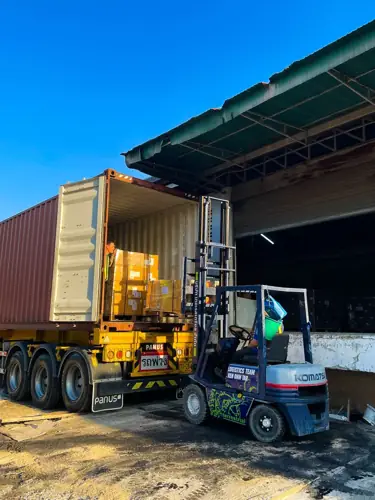
Open areas are a standard component of logistics parks: they are used for manoeuvring and parking vehicles, for container storage and for storing goods that do not need a roof. Their cost per square metre is lower than that of covered space, because it does not include the structure, roof and internal installations. The advantage ends, however, where the goods risk deterioration or the policy stops covering them.
This article lists the criteria that operators and clients use to decide what goes into the yard and what stays in the warehouse.
The basic criterion: the goods and their packaging
The question to ask concerns how the goods behave under sun, rain, wind, frost and day-night temperature swings, for the whole expected length of storage. The second criterion is packaging: the same goods may be suitable for outdoor storage in a closed crate and unsuitable on a stretch-wrapped pallet.
Suitable goods, with the precautions indicated:
- closed containers, full or empty, awaiting unloading, collection or shipment;
- building materials: bricks, blocks, precast concrete products, cast-iron and steel pipes; PVC pipes and other plastics can degrade with prolonged UV exposure, so they should be covered or limited to short stays;
- unpainted steel coils, sections and sheets intended for further processing, taking into account the risk of surface oxidation;
- machinery and steelwork with outdoor packaging (closed crates, tarpaulins, anti-condensation barriers);
- vehicles, construction plant, trailers and semi-trailers;
- construction timber, if moisture does not compromise its use.
Goods to keep under cover:
- food, beverages, pharmaceutical and cosmetic products;
- paper, board, packaging and printed products;
- textiles, upholstered furniture, electronics and small appliances;
- temperature-sensitive chemicals or paints;
- all goods intended for order picking, which must be located, accessible and countable.
Goods that require defined temperature ranges need temperature-controlled areas, with data monitoring and recording, and are not compatible with outdoor storage.
Containers in the yard: protection and dwell costs
The shipping container, in the standard 20 and 40 foot sizes defined by ISO 668, is in effect a small closed warehouse. It protects from rain and intrusion, but not from condensation: with large temperature swings, moisture settles on the internal walls and can damage cartons and metals. For stays of several weeks, desiccant bags, ventilation or unloading into the warehouse are used.
There is also an economic question. Containers owned by shipping lines have a free period of use (free time) set in the contract of carriage; beyond that threshold the line charges demurrage and detention. In many cases it pays to unload the container, return it empty and store the goods on pallets. The comparison is made by adding the cost of unloading and palletising to that of storage and setting the total against the sea carrier’s daily dwell charges.
Wood packaging for export outside the EU must also comply with the FAO international phytosanitary standard ISPM 15 (treatment and marking), which also applies to pallets and crates that have stood in the yard for a long time.
Yard requirements
An open area used for third-party storage must meet a number of technical and safety requirements:
- paving suited to the weight of the goods and the handling equipment: counterbalance forklifts, reach stackers for containers, mobile cranes for heavy loads;
- drainage of rainwater, to avoid standing water under the goods;
- a site layout that separates storage areas from traffic routes and from manoeuvring areas for articulated lorries, with floor markings;
- fencing, lighting, video surveillance and access control, because goods stored outdoors are more exposed to theft;
- safety distances from buildings and combustible materials, according to the fire risk assessment.
For indoor storage, fire prevention legislation sets specific thresholds: DPR 151/2011 includes among the activities subject to fire brigade (Vigili del Fuoco) inspection (activity 70) premises used for storage with a gross floor area above 1,000 square metres and quantities of combustible goods and materials above 5,000 kilograms. Both conditions must apply together. Outdoor storage of certain categories of materials is covered by separate entries in the same list, to be checked case by case with a qualified technician.
Insurance: the most underestimated point
Moving goods from the warehouse to the yard can change insurance cover without the client noticing. Several information sets for business multi-risk policies exclude «enti all’aperto» (property kept outdoors) from fire cover, except for tanks and fixed installations; other policies cover goods outdoors, weather events affecting goods outside or theft in fenced areas only as paid special conditions.
Four checks should be made before moving goods outdoors:
- the client’s cargo policy, and whether it covers an outdoor location at a third party’s premises;
- weather event cover (hail, wind, flooding) for goods outdoors;
- theft cover in a fenced and guarded area;
- the depositary’s liability, its contractual limits and the policy that backs it.
Asking the insurer for written confirmation, with the site address and a description of the area, is the practice that avoids disputes after a loss.
Covered and open space on the same site
The most common solution is mixed: sensitive goods stay under cover, robust and bulky goods go into the yard, and the two flows share docks, equipment and information system. Having both areas on the same site avoids transfers between different warehouses and allows goods to be moved indoors when the season or destination changes. The WMS (warehouse management system) must also manage outdoor locations, because a stock count that does not include the lots in the yard is not complete.
The Latina Scalo site
Consorzio Logistico Latina Scalo manages, in Via della Dinamica, Latina Scalo (LT), 19,000 square metres of covered space and 25,000 square metres of open areas, with yards for manoeuvring articulated lorries, covered loading and unloading bays, perimeter video surveillance, access control and fire and intrusion protection systems. The dedicated service is described on the open yards page; for the sectors that most often use outdoor storage, see the construction and manufacturing sector pages, and for the area served, the logistics in the province of Latina page.
Sources
- ISO 668, Series 1 freight containers — Classification, dimensions and ratings: iso.org
- FAO / IPPC, ISPM 15, Regulation of wood packaging material in international trade: ippc.int
- DPR 1 agosto 2011, n. 151, Annex I, activity 70; summaries on when storage premises are subject to inspection: certifico.com and biblus.acca.it
- Argo Global, Multirischi Commercio information set (exclusion of property kept outdoors): argogroup.com
- Site facilities: statements by Consorzio Logistico Latina Scalo.