Cross-docking: when transit without storage makes sense
In cross-docking, goods move from the receiving bay to the dispatch bay without being put into stock. It makes sense when flows are predictable, unit loads arrive already identified and the transport savings exceed the cost of coordinating arrivals and departures.
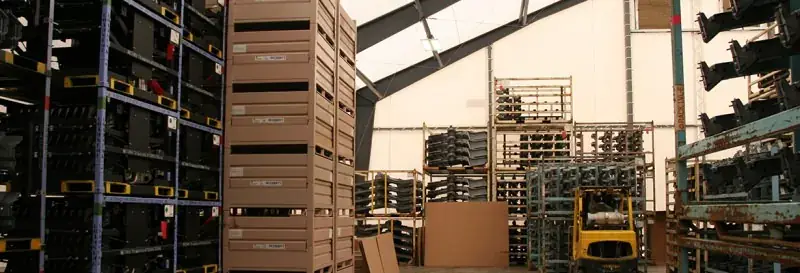
Cross-docking is a flow management technique in which goods enter through the receiving bay and leave through the dispatch bay without being put away into stock. The warehouse acts as a sorting point: it receives loads from several origins, breaks them down and rebuilds them by destination, and reloads them onto outgoing vehicles, normally on the same day. The service is paid per unit handled, not per unit of stock held.
Whether it makes sense depends on a precise comparison: the transport savings obtained by consolidating or splitting loads must exceed the cost of coordinating arrivals and departures.
Two operating models
Pre-distributed cross-docking is the simplest form. The supplier prepares cartons or pallets already assigned to each delivery point, labelled with the consignee; the warehouse receives them, scans them and moves them to the corresponding departure bay. Dwell time is short and the risk of error is low, because the allocation decision has been taken upstream.
In post-distributed cross-docking the goods arrive in aggregate form, for example single-SKU pallets, and allocation to consignees is decided in the warehouse. Picking and pallet rebuilding are required, with a work content similar to order picking but without putting goods into stock. This is the model used by the distribution centres of large-scale retailers, which receive from suppliers and replenish stores with mixed pallets.
There is also pure transit, in which the unit load is not broken down but simply transferred from one vehicle to another: this is the case of a semi-trailer unloading full pallets destined for last-mile vans.
When it makes sense
Cross-docking gives the best results when several conditions occur together:
- predictable and regular flows, with stable daily volumes or volumes planned in advance;
- unit loads identified at origin with barcodes or logistics labels that the warehouse system can read;
- an advance shipping notice (ASN) telling the warehouse what will arrive, when and for whom;
- several origins to several destinations, where consolidation makes it possible to fill vehicles: for example several suppliers in northern Italy shipping part loads to a network of customers in southern Lazio;
- high-turnover or perishable goods, for which dwelling in the warehouse is a cost or a risk.
A frequent case in central and southern Italy involves a long full-load leg from the north to a regional sorting point, followed by deliveries with smaller vehicles. Over long distances a full load costs less per pallet than a part load or groupage; regional cross-docking turns one full load into many short deliveries.
When it does not make sense
Cross-docking becomes a cost when:
- arrivals are not on time and outgoing vehicles have to wait, or leave half empty;
- consignee demand is uncertain, so the goods received have no definite destination at the time of unloading;
- the goods require lengthy quality checks, quarantine or sampling before release;
- the accompanying data is incomplete and the warehouse has to identify cartons and consignees manually.
In all these cases the goods end up dwelling in the sorting area, which is not equipped as a storage area: this creates congestion, risk of error and unplanned storage costs. For this reason contracts include a free dwell time allowance, for example 24 or 48 hours, beyond which the storage rate applies.
Warehouse requirements
A site offering cross-docking needs:
- enough loading bays, ideally with separate sectors for arrivals and departures, to avoid crossing flows;
- a floor staging area in front of the bays, sized for the maximum number of pallets in transit at any one time;
- yards for parking and manoeuvring articulated lorries while they wait, so as not to block external roads;
- a WMS (warehouse management system) that handles receiving against advance notice, allocation by consignee and load confirmation by barcode scanning;
- booked time slots for arrivals and departures, because waiting time at the dock is the first indicator of poorly coordinated cross-docking.
Document management is an integral part of the service: every handover requires consistent documents, from the supplier’s DDT (Italian delivery note) to the outgoing carrier’s consignment note. The rules are described in the article on transport documents.
How the cost is calculated
The service fee is usually expressed per unit handled (pallet, carton or shipment), with surcharges for labelling, re-wrapping or rebuilding. The economic comparison should be made across the whole chain:
- cost of inbound transport with consolidation, compared with direct shipments from supplier to consignee;
- cost of outbound transport, with smaller vehicles closer to the consignees;
- cost of passing through the warehouse, per unit handled;
- cost of risks: delays, dwell beyond the free allowance, sorting errors.
If the sum of the first three items is lower than the cost of direct shipments, and the fourth remains limited, cross-docking makes sense.
The southern quadrant
In the area between south Rome and Latina, large-scale retail distribution centres and logistics operators are concentrated mainly in the Santa Palomba industrial area, which is also home to the Pomezia–Santa Palomba intermodal terminal, the largest in Lazio by intermodal transport units handled according to the regional mobility, transport and logistics plan (PRMTL). A cross-docking operation south of this cluster serves in particular deliveries to the province of Latina and southern Lazio, so that vehicles heading south do not have to cross the metropolitan area.
The Latina Scalo site
Consorzio Logistico Latina Scalo, in Via della Dinamica, Latina Scalo (LT), offers cross-docking among its handling services, with covered loading and unloading bays, yards for manoeuvring articulated lorries and vehicle parking areas on 25,000 square metres of open space, as well as 19,000 square metres of covered space and a WMS. The service is combined with transport by a dedicated fleet. By road the site is about 50 kilometres from Pomezia and about 55 from Santa Palomba (OSRM calculation for cars). For the areas served, see the pages on logistics in the province of Latina and large-scale retail.
Sources
- Regione Lazio, PRMTL, Il Sistema della Logistica (Pomezia–Santa Palomba terminal): regione.lazio.it
- Piano di Sviluppo Strategico della ZLS del Lazio, October 2025, pp. 35–36 (logistics operators and retail distribution centres in Santa Palomba): politichecoesione.governo.it
- Consorzio Industriale del Lazio, industrial areas (Santa Palomba): consorzioasi.com
- Distances and times: OSRM route calculation from the Via della Dinamica site, car, normal traffic; calculation by the Consorzio.
- Services and facilities: statements by Consorzio Logistico Latina Scalo.