Last mile to south Rome from Latina: road times, ZTL rules and time windows
From Latina Scalo, the main districts of the southern quadrant of Rome, between Castel Romano and Garbatella, can be reached by road in about 55-80 minutes in normal traffic, according to the OSRM route calculation. Delivery planning must take account of the Fascia Verde, the rules of the goods vehicle ZTL and the trial scheme introduced in 2026 for the historic centre.
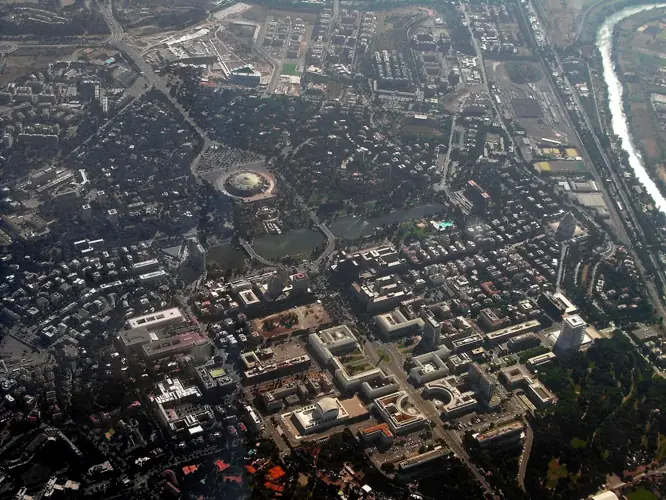
Serving the southern quadrant of Rome from a warehouse outside the Grande Raccordo Anulare (GRA, Rome’s orbital motorway) means adding an outbound and return transfer to every delivery round. The starting point is therefore road distance. From the Via della Dinamica site in Latina Scalo (LT), the OSRM route calculation for cars in normal traffic gives about 70 kilometres and about 70 minutes to EUR, about 55 kilometres to Santa Palomba and about 50 kilometres to Pomezia.
The second factor is the rules on access to the city for goods vehicles, which in Rome operate on several levels and in 2026 were the subject of a trial scheme and of litigation.
Road times to the southern quadrant
The table shows distances and times from the Latina Scalo site to the areas of Rome and its southern hinterland most frequently served by B2B deliveries. The values are calculated with OSRM for cars in normal traffic: for vans and lorries, and at peak hours, actual times are longer.
| Destination | Road distance | Estimated time |
|---|---|---|
| Pomezia | about 50 km | about 50 minutes |
| Santa Palomba | about 55 km | about 57 minutes |
| Castel Romano | about 57 km | about 56 minutes |
| Morena | about 53 km | about 70 minutes |
| Anagnina | about 58 km | about 75 minutes |
| Spinaceto | about 65 km | about 65 minutes |
| Tor Vergata | about 67 km | about 75 minutes |
| Torrino | about 69 km | about 68 minutes |
| EUR | about 70 km | about 70 minutes |
| Laurentino | about 71 km | about 72 minutes |
| Magliana | about 72 km | about 73 minutes |
| Ostiense | about 74 km | about 76 minutes |
| Garbatella | about 75 km | about 79 minutes |
| Ostia | about 84 km | about 94 minutes |
Two routes divide the quadrant. The western areas (EUR, Torrino, Spinaceto, Magliana) are reached via the SS148 Pontina state road, which between Rome and Borgo Piave has two separate carriageways with two lanes in each direction; on the section between Pomezia and Latina north the speed limit has been lowered from 110 to 80 km/h. The eastern areas (Morena, Anagnina, Tor Vergata) require routes through the Castelli Romani road network or on the GRA, with longer times for the same distance, as shown by the 70 minutes estimated for Morena against 53 kilometres.
For vehicles over 3.5 tonnes the Italian Highway Code (Art. 142) sets lower speed limits than for cars: 80 km/h on main non-urban roads and 70 km/h on secondary roads.
Access rules: four levels
Fascia Verde
The Fascia Verde (green belt) coincides with the area inside the GRA. According to the summary published by Sicurauto on 19 January 2026, it is in force Monday to Saturday, excluding mid-week public holidays, and bans the most polluting vehicles; on days of high pollution the ban is progressively extended to other classes, up to Euro 6 diesels. For a fleet working in Rome, the vehicles’ emission class is therefore an operational requirement, not just a tax matter.
Goods vehicle ZTL and VAM ZTL
The limited traffic zones (ZTL) of the centre (Centro Storico, Tridente, Trastevere) have separate rules for cars and for goods vehicles. According to the same Sicurauto summary:
- the VAM ZTL is closed to vehicles over 7.5 metres long every day from 05:00 to midnight;
- in the goods vehicle ZTL (ZTL Merci), vehicles up to 35 quintals of Euro 4-6 class are banned from 17:30 to 20:00;
- heavier vehicles, and electric, LPG, methane or hybrid vehicles over 65 quintals, are banned from 07:00 to 20:00;
- petrol and diesel lorries from Euro 0 to Euro 3 cannot enter.
Access requires a permit, issued and paid for through the services of Roma Servizi per la Mobilità.
The 2026 trial scheme for the historic centre
By mayoral ordinance No 105 of 31 July 2026, Roma Capitale introduced, on a trial basis from 7 September to 7 December 2026, a ban on access from 08:00 to 18:00 for goods vehicles in ZTL A1 (Tridente) and neighbouring areas, even for vehicles with a permit. According to Sicurauto (3 August 2026), vehicles already inside the perimeter could operate until 09:30 and those carrying temperature-controlled foodstuffs until 10:00, with exemptions for medicines, authorised construction sites, removals and emergency services.
Between 2 and 4 September the Lazio Regional Administrative Court (TAR) granted the requests for interim suspension filed by express couriers and by a food and beverage delivery company, suspending the measure for the applicants pending the full hearing set for 23 September 2026. The outcome of that hearing had not been verified at the date of this article: anyone planning deliveries in the Tridente should check the status of the measure on the Roma Mobilità website.
Changes announced for 2027
Roma Capitale’s councillor for mobility, Eugenio Patanè, announced in August 2026 that electronic gates would also be activated on exit from the ZTLs, starting with the Centro Storico, with a target date of 7 January 2027, and that deliveries would be divided into time bands by category of goods, according to perishability and urgency. Sensors are planned in loading and unloading bays, linked to a booking system for accredited vehicles. These are announced measures, to be verified when they come into force.
Delivery windows and round planning
With a transfer of about one hour each way, organising the delivery round becomes a matter of timing. Four constraints have to be reconciled:
- the consignees’ receiving windows: shops and offices generally receive in the morning, while retail distribution centres work on booked slots;
- the restriction periods of the goods vehicle ZTL and the Fascia Verde, which vary by vehicle weight and class;
- the driving and rest times under Regulation (EC) 561/2006 for vehicles over 3.5 tonnes: a maximum of 9 hours’ daily driving, extendable to 10 twice a week, and a 45-minute break after 4 hours 30 minutes of driving;
- the delivery density per round, which determines the cost per delivery: more stops concentrated in the same area reduce the weight of the transfer.
In practice two models are combined. The first is a dawn departure with vehicles loaded the evening before, to reach the city before the restriction periods and peak traffic. The second is break-bulk: a heavy vehicle transfers the goods to a transit point closer to the city, from which light or electric vans make the deliveries; this is the cross-docking model.
The Latina Scalo site
Consorzio Logistico Latina Scalo operates in Via della Dinamica, Latina Scalo (LT), with 19,000 square metres of covered space, 25,000 square metres of open areas and yards for manoeuvring articulated lorries. The transport service includes road distribution with a dedicated fleet and last-mile delivery; the warehouse also handles cross-docking. For the areas served, see the pages on logistics in Rome and south Rome.
Sources
- Distances and times: OSRM (Open Source Routing Machine) route calculation from the Via della Dinamica site, car, normal traffic; calculation by the Consorzio.
- SS148 Pontina, carriageways and limits: Wikipedia, Strada statale 148 Pontina (ANAS data)
- Sicurauto, Ztl Roma: orari 2026, mappa e permessi, 19 January 2026: sicurauto.it
- Sicurauto, Ztl Roma: carico e scarico merci, nuove regole dal 7 settembre, 3 August 2026: sicurauto.it
- Trans.info, on ordinance No 105 of 31 July 2026: trans.info
- Sicurauto, on the interim suspension by the TAR Lazio, 7 September 2026: sicurauto.it; Motor1, 7 September 2026: it.motor1.com
- Sky TG24, on exit gates and time bands by category of goods, 25 August 2026: tg24.sky.it
- Roma Servizi per la Mobilità, permits and current rules: romamobilita.it
- Codice della strada (Italian Highway Code, D.Lgs. 285/1992), Art. 142: normattiva.it
- Regulation (EC) No 561/2006, Arts. 6 and 7: eur-lex.europa.eu