Cost of a pallet space: how a storage rate is calculated
A third-party storage rate is made up of several components: the space occupied, inbound and outbound handling, ancillary services and insurance cover. Comparing two offers requires bringing them to the same calculation basis, starting from the average stock and the turnover of the goods.
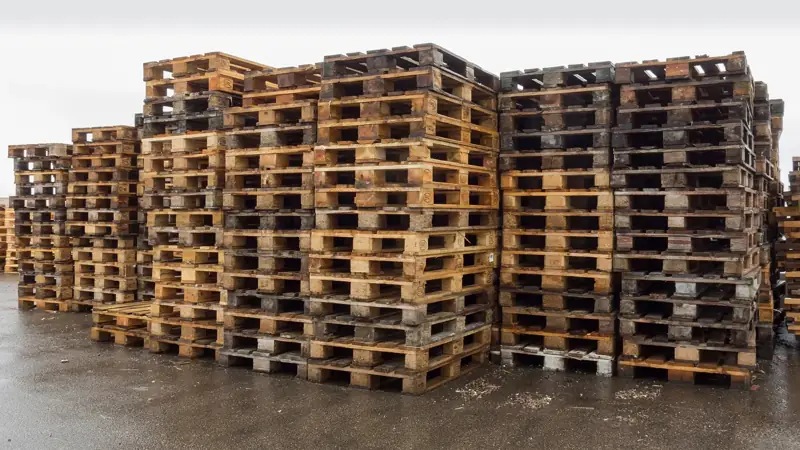
In a third-party storage contract the price is not a single number. Logistics operators’ offers break the service down into at least four components: the space occupied, inbound and outbound handling, ancillary services and insurance. Two quotes with the same amount per pallet space can therefore produce very different annual costs, depending on how the other components are priced and which stock level is invoiced.
This article describes the calculation method and the factors that influence it. It does not give market prices: rates depend on the goods, volumes and duration, and should be requested on the basis of precise operational data.
The unit of measurement: pallet space, square metre, cubic metre
The pallet space is the most widely used unit of capacity for palletised goods. The reference in Europe is the 1,200 × 800 millimetre EPAL pallet, whose dimensions are set by the UNI EN 13698-1 standard. A pallet space is a location, in pallet racking or on the floor, that holds one unit load within set height and weight limits.
Two parameters change the value of a pallet space:
- unit load height: a pallet 1.8 metres high occupies a larger bay than one 1.2 metres high and reduces the number of possible levels below the beams;
- weight: above the load capacity provided for the bay, the pallet has to be placed at floor level or in dedicated areas.
For oversized or non-stackable goods, or goods stored on the floor, the more accurate calculation basis is the square metre (or the cubic metre), because the number of pallets does not describe the space actually taken up. Coils, machinery, oversized crates and building materials generally fall into this category. For open-air storage, see the article on covered warehouse or open yard.
From space to price: the ratio between square metres and pallet spaces
For the operator, the starting cost is that of the building: rent or depreciation, maintenance, installations, security. The conversion from square metres to pallet spaces depends on the layout. For the same floor area, the number of pallet spaces increases with:
- the clear height of the building, which determines the number of racking levels;
- the aisle width, which depends on the type of forklift (counterbalance, reach truck, turret truck);
- the share of the floor area used for receiving, dispatch and order picking.
The calculation is set up as follows: annual cost of the area (building and installations) divided by the number of pallet spaces that can actually be sold, divided by twelve, plus the share of overheads and margin. A warehouse with low occupancy spreads the same fixed cost over fewer pallets: this is why many offers include a guaranteed minimum of pallet spaces or a fixed fee for a dedicated area.
Which stock level is invoiced
This is the component that creates the largest differences between apparently similar offers. There are three common methods:
- point-in-time stock: stock is counted on a fixed date, for example the last day of the month;
- average stock: the average of daily or weekly stock levels over the period is calculated;
- pallet-days: the number of pallets present each day is added up and a daily rate is applied.
A numerical example, without prices, shows the effect. A client brings 600 pallets into the warehouse on the first of the month, ships 20 on each of the 21 working days and receives 300 on the last day. With point-in-time stock at month end, the invoice counts 480 pallets; with the monthly average stock, the count falls to around 400; with pallet-days, the result is similar to the average but reflects the exact timing of arrivals. In the example the difference between the two methods is 20%; with seasonal stock, as in agri-food or holiday products, it can be wider. The method should be written into the contract, together with the rule for part pallets.
Turnover and handling
Turnover is measured as annual outbound volume divided by average stock. Goods that turn over twelve times a year remain in the warehouse for one month on average; goods that turn over twice a year remain for six months. High turnover means less space per unit sold but more movements, and therefore more dock and forklift work.
Handling is priced per event:
- inbound: unloading, quantity check, pallet labelling, registration in the WMS (warehouse management system) and put-away. Unloading a container of loose cartons costs much more than unloading ready-built pallets, because it requires palletising on the floor;
- outbound: retrieval from the location, checking, stretch-wrapping and loading onto the vehicle;
- order picking: per carton or per order line when picking is by item rather than by full pallet.
When comparing offers it is useful to reconstruct a typical month: average stock multiplied by the storage rate, plus the number of inbound and outbound pallets multiplied by the respective rates, plus order lines multiplied by the picking rate. The pages on the handling and storage services describe the activities included in each component.
Insurance and liability
The deposit contract is governed by Articles 1766 et seq. of the Italian Civil Code; Article 1768 requires the depositary to exercise the diligence of a «buon padre di famiglia» (the reasonable person standard) in safekeeping. This does not mean that the value of the goods is insured by the warehouse. In practice, a distinction is made between:
- the depositary’s liability for damage caused by its own fault, often limited in the contract per kilogram or per event;
- the cargo policy, covering fire, theft and weather events, which may be taken out by the client or by the operator with the premium passed on.
Policy conditions should be read carefully: several information sets for business multi-risk policies exclude «enti all’aperto» (property kept outdoors) from basic cover and cover it only through specific extensions (see for example the Multirischi Commercio information set from Argo Global). For goods transported from the warehouse to the customer, transport rules apply instead, including the limit of 1 euro per kilogram of gross weight laid down by Article 1696 of the Civil Code for domestic carriage, unless a value is declared or otherwise agreed.
Ancillary services and fixed items
In addition to space and handling, a complete offer lists:
- value-added services: labelling and relabelling, kitting, repacking, priced per item or per hour;
- stock counts: the annual stocktake is often included; extraordinary or additional cycle counts are priced by the hour;
- document management: issuing DDTs (Italian delivery notes), reporting, integration with the client’s management system;
- start-up: setting up master data, item coding, any IT interfaces;
- special conditions: temperature control, high-value goods in a secure area, goods subject to specific regulations.
Contract duration and comparing offers
Duration affects price because it spreads start-up costs and reduces the operator’s risk of empty space. According to the “Gino Marchet” Contract Logistics Observatory of the Politecnico di Milano, cited by Shipping Italy in November 2025, the average duration of warehousing contracts in Italy fell from 3.4 to 3 years over the period observed since 2017. For more on contract clauses, see the guide to the third-party logistics contract.
To obtain comparable quotes it is advisable to give all operators the same set of data: pallet type, height and weight, stackability, average and peak stock, monthly inbound and outbound movements, order profile, expected duration and ancillary services.
The Latina Scalo site
Consorzio Logistico Latina Scalo has, in Via della Dinamica, Latina Scalo (LT), 19,000 square metres of covered space in modular buildings from 500 to 3,000 square metres, with a clear height of up to 10 metres and provision for pallet racking, plus 25,000 square metres of open areas. Rates are calculated per pallet space or per square metre, based on duration and volumes, with handling priced separately; stock is recorded in the WMS. For a quote, please provide the data listed above. Further information is on the logistics in Latina page and in the frequently asked questions.
Sources
- UNI EN 13698-1, production specification for 800 × 1,200 mm flat wooden pallets: store.uni.com
- Codice civile (Italian Civil Code), Arts. 1766–1782 (deposit) and Art. 1696 (limits on compensation in carriage), current text on Normattiva; commentary on Art. 1696 on miolegale.it
- Shipping Italy, Quanto vale e come evolve la logistica conto terzi in Italia, 13 November 2025, data from the “Gino Marchet” Contract Logistics Observatory of the Politecnico di Milano: shippingitaly.it
- Argo Global, Multirischi Commercio information set (exclusion of property kept outdoors from fire cover): argogroup.com
- Site facilities: statements by Consorzio Logistico Latina Scalo.