Gaeta, Civitavecchia, Naples and Salerno: the ports used by Pontine companies
In 2025 the port of Gaeta handled about 1.8 million tonnes, almost entirely bulk cargo, while Civitavecchia exceeded 8.1 million tonnes with 114,662 TEU and growing ro-ro traffic. For containers, companies in the province of Latina also look to the Campanian ports of Naples and Salerno, about 190 and 230 kilometres away by road.
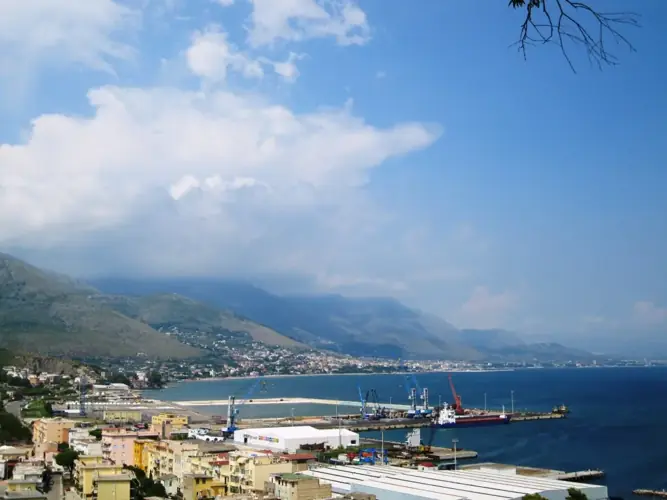
Companies in the province of Latina have four commercial ports within about 230 kilometres by road: Gaeta and Civitavecchia in Lazio, managed by the Port System Authority of the Central-Northern Tyrrhenian Sea (AdSP), and Naples and Salerno in Campania, which come under the AdSP of the Central Tyrrhenian Sea. In 2025 the system of the ports of Rome and Lazio, which also includes Fiumicino, handled 13,128,936 tonnes of goods (+0.3%), according to AdSP data reported by Shipping Italy. The ports perform different functions, and the choice depends on the type of cargo: bulk, rolling stock or containers.
Gaeta: bulk and general cargo
The port of Gaeta is the commercial port closest to the Pontine area. In 2025 it handled 1,786,317 tonnes (-0.7%), with traffic consisting almost entirely of bulk cargo: dry bulk grew by 12%, with metallurgical products up 86.6%, while liquid bulk fell by 10.6%. General cargo increased by 67.5% and ship calls by 27%. In the first half of 2026 the port recorded 935,202 tonnes (+13%) and 131 berthings (+12%).
Gaeta is a Comprehensive node of the TEN-T trans-European transport network and is included in the Lazio Simplified Logistics Zone (ZLS) with 17.53 hectares of port areas, in addition to 142.61 hectares in the municipal area, according to Annex 2 to Lazio regional resolution (DGR) 291/2025. In February 2026 Shipping Italy reported that two operators, Interminal and Steinweg GMT, had been asked to revise their concession applications for areas of the port.
A new customs instrument is linked to the port. Law No 199 of 30 December 2025 (Art. 1(453)) provides for the establishment of enclosed customs free zones in Lazio, with boundaries proposed by the AdSP for the areas under its jurisdiction and by the Region for the others, to be approved by decision of the Customs and Monopolies Agency. At the presentation of the free zone at the Frosinone-Latina Chamber of Commerce, reported by Shipping Italy on 3 February 2026, the President of the AdSP, Raffaele Latrofa, said that the port of Gaeta must be integrated with the port hinterland, the logistics platforms and the industrial system of the provinces of Latina and Frosinone.
Civitavecchia: ro-ro, containers and cold chain
Civitavecchia is the main port in Lazio. In 2025 it handled 8,125,234 tonnes (+3.1%), 61.9% of the regional system. Ro-ro traffic exceeded 5.2 million tonnes (+5.6%) and containers reached 114,662 TEU (+7.6%), with full containers up 10.7%. At system level, vehicles handled exceeded 1,003,000 (+7.2%), including more than 214,000 heavy commercial vehicles (+5.7%).
The first half of 2026 confirms the trend: 3,927,737 tonnes (+1.5%), 60,502 TEU (+6.9%) and 437,310 vehicles (+14.3%), with new cars shipped as cargo up 49.1%.
For Pontine companies the port has a specific role in the cold chain. The Strategic Development Plan of the Lazio ZLS notes the tendency of the Pomezia and Latina pharmaceutical industry to look to Civitavecchia «come naturale nodo» (as its natural node), partly because of the port’s cold chain potential, and lists refrigerated agri-food among the port’s specialisations. The regional mobility, transport and logistics plan (PRMTL) provides in the long term for a rail connection to the Fiumicino logistics platform (CIRF), which would act as an inland port for Civitavecchia along the route to Santa Palomba.
Fiumicino: an energy port
In 2025 the port of Fiumicino handled 3,217,385 tonnes (-5.8%), mainly jet fuel for Leonardo da Vinci airport. It has no container or ro-ro traffic of relevance to Pontine industry; its logistics importance for the area lies rather in the airport’s Cargo City and the adjacent logistics platform.
Naples and Salerno: containers in the southern Tyrrhenian
For containers, particularly those bound for destinations outside the Mediterranean, companies in southern Lazio also use the Campanian ports. Salerno Container Terminal (SCT) exceeded 400,000 TEU a year in December 2025 for the first time in its history, and expected to close the year close to 420,000 TEU (+16% on 2024), according to Shipping Italy; the milestone was marked by a ship on the weekly Hapag-Lloyd and Maersk Tex service to the United States. The terminal announced the acquisition of a 70,000 square metre back-of-port area for 2026.
For Naples, an analysis published by Shipping Italy in March 2026 based on Port System Authority data, comparing 2025 hinterland container traffic with 2018 levels, lists the Neapolitan port’s import discharges (+39%) among the best performances. For both ports, the AdSP of the Central Tyrrhenian Sea’s total 2025 TEU figures have not been verified from a primary source.
Distances and routes
From the Latina Scalo industrial area, road distances calculated with the OSRM routing engine for cars are as follows:
| Port | Road distance (approx.) | Main route |
|---|---|---|
| Gaeta | 70 km | SS7 Appia / SS148 Pontina, Terracina, Formia |
| Civitavecchia | 140 km | SS148 Pontina, GRA, A12 |
| Naples | 190 km | SS7 Appia and Formia, or SS156 and A1 |
| Salerno | 230 km | A1 and A3 |
Journey times for heavy goods vehicles are considerably longer than for cars. The route to Civitavecchia crosses the Rome node and the GRA (Rome’s orbital motorway); towards Naples and Salerno, access to the A1 is currently via the Frosinone, Valmontone or Colleferro toll gates, pending the Cisterna-Valmontone link road.
What export flows indicate
Exports from the province of Latina, over 10 billion euros in 2025 according to the Frosinone-Latina Chamber of Commerce on ISTAT data, go 88% to Europe. The first market is Belgium, with 5.3 billion euros, which the Chamber describes as a logistics destination for the large pharmaceutical multinationals. The geography of markets indicates that a significant share of Pontine exports goes to European distribution centres that can be reached overland; the use of ports concerns to a greater extent industrial bulk cargo, rolling stock and containers bound for non-European markets, such as the United States (907 million euros of Pontine manufacturing exports in 2025).
The Latina Scalo site
Consorzio Logistico Latina Scalo, in Via della Dinamica, is about 70.1 kilometres by road from the port of Gaeta (OSRM calculation). With 25,000 square metres of open areas for parking and manoeuvring articulated lorries and 19,000 square metres of covered space, the site offers storage, handling and cross-docking and road transport for goods arriving at or leaving the Tyrrhenian ports. Distances from other nodes are on the location page and on the province of Latina page.
Sources
- Shipping Italy, «Nei porti del Lazio oltre 13,1 mln di tonnellate e 3,5 mln di crocieristi nel 2025» (17 February 2026): https://www.shippingitaly.it/2026/02/17/nei-porti-del-lazio-oltre-131-mln-di-tonnellate-e-35-mln-di-crocieristi-nel-2025/
- Shipping Italy, «Merci +1,5% e crocieristi +8,9%: in aumento a Civitavecchia nella prima metà del 2026» (18 August 2026): https://www.shippingitaly.it/2026/08/18/merci-15-e-crocieristi-89-in-aumento-a-civitavecchia-nella-prima-meta-del-2026/
- AdSP del Mar Tirreno Centro-Settentrionale, Traffici 2025: https://portidiroma.it/sites/default/files/allegati/Traffici%20AdSP%20del%20Mar%20Tirreno%20Centro%20Settentrionale%20-%20Anno%202025.pdf
- Shipping Italy, «Il porto di Gaeta per lo sviluppo della zona franca doganale Latina-Frosinone» (3 February 2026): https://www.shippingitaly.it/2026/02/03/il-porto-di-gaeta-per-lo-sviluppo-della-zona-franca-doganale-latina-frosinone/
- Shipping Italy, «Interminal e Steinweg Gmt chiamate a rimodulare le proprie istanze a Gaeta» (9 February 2026): https://www.shippingitaly.it/2026/02/09/interminal-e-steinweg-gmt-chiamate-a-rimodulare-le-proprie-istanze-a-gaeta/
- Regione Lazio, notice on enclosed customs free zones, Avviso Zone Franche Doganali intercluse (DD G04864 of 15/04/2026): https://www.regione.lazio.it/sites/default/files/documentazione/2026/SVI-DD-G04864-15-04-2026-Avviso.pdf
- Shipping Italy, «Salerno Container Terminal supera il traguardo dei 400mila Teu annuali» (22 December 2025): https://www.shippingitaly.it/2025/12/22/salerno-container-terminal-supera-il-traguardo-dei-400mila-teu-annuali/
- Shipping Italy, «Il traffico container gateway dei porti italiani tornato ai livelli del 2018» (14 March 2026): https://www.shippingitaly.it/2026/03/14/il-traffico-container-gateway-dei-porti-italiani-tornato-ai-livelli-del-2018/
- Regione Lazio, DGR 291/2025, Allegato 2 – Estensione in ettari per Comune: https://regione.lazio.it/sites/default/files/documentazione/2025/DGR-291-2025-allegato2-estensione-ettari-per-comune.pdf
- Piano di Sviluppo Strategico ZLS Lazio: https://politichecoesione.governo.it/media/pixdvzjt/piano-di-sviluppo-stratetegico.pdf
- Regione Lazio, PRMTL – Il Sistema della Logistica: https://www.regione.lazio.it/sites/default/files/2022-11/Il-Sistema-Logistica.pdf
- Camera di Commercio Frosinone-Latina, «Frosinone e Latina sui mercati internazionali – Anno 2025»: https://www.frlt.camcom.it/sites/default/files/contenuto_redazione/Osserfare/Frosinone%20e%20Latina%20sui%20mercati%20internazionali%20Anno%202025%20revMR.pdf
- OSRM (Open Source Routing Machine), road route calculation: https://project-osrm.org/