Cross-docking in Latina Scalo for distribution in Lazio
Cross-docking in Latina Scalo (LT): unloading, sorting by destination and reloading without storage, with covered bays and yards for articulated lorries.
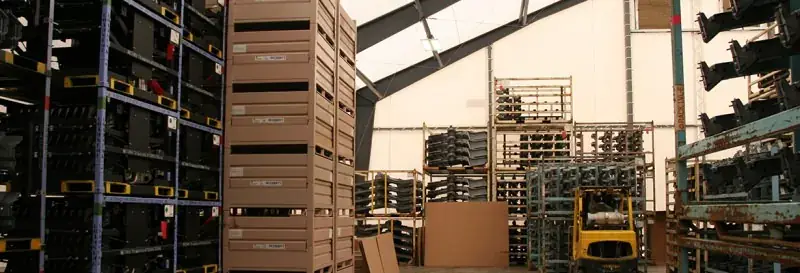
Transit without storage in Latina Scalo
Consorzio Logistico Latina Scalo carries out cross-docking at the Via della Dinamica site, Tor Tre Ponti area, Latina Scalo (LT). Incoming goods are unloaded, checked, sorted by destination and reloaded onto other vehicles without being put away in storage locations. The service uses the covered loading and unloading bays and the yards for articulated lorry manoeuvring, with parking areas for waiting vehicles.
Cross-docking reduces intermediate handling and the time goods spend in the warehouse. It suits flows whose destination is already known on arrival, where the value of passing through the site lies in the change of vehicle and the rebuilding of loads.
When it is used
There are four common cases:
- deconsolidation: a full load arriving from a plant or a port is split into deliveries for several consignees in the province of Latina and the southern districts of Rome;
- consolidation: shipments from several suppliers bound for the same area are combined on a single vehicle;
- store replenishment: goods destined for a network of shops are rebuilt by outlet, typical of large-scale retail;
- inter-site transfers: the site acts as an interchange point between the client’s plants or depots, for example in the automotive and manufacturing supply chains.
The operating process
Arrival booking
The client or supplier gives advance notice of the vehicle’s arrival, with details of pallets or packages and planned destinations. Unloading time slots are allocated so as to reduce waiting times at the dock and coordinate arrivals with outbound departures.
Unloading and checking
The vehicle docks at a covered bay. The operator checks the goods against the transport document (DDT, Italian delivery note), counts the units, checks the condition of the packaging and notes any reservations on the carrier’s document. The units are recorded in the WMS (warehouse management system) as goods in transit.
Sorting
Units are assigned to outbound areas by destination, delivery round or carrier. Where the flow requires it, the operator breaks down mixed pallets and builds new units per consignee, with new labelling and stretch wrapping. Packaging operations are described on the value-added services page.
Reloading and dispatch
Sorted units are loaded onto outbound vehicles, from the Consortium’s dedicated fleet or third-party carriers. On loading, the transport document is issued and the unit’s departure is recorded in the WMS; the client receives confirmation with the shipment references, as described on the document management page.
Technical dwell
When arrivals and departures do not coincide, goods can stay for a limited time in a transit area. If the dwell exceeds the agreed time, the unit is taken into stock and handled under the storage rules. The maximum dwell time is set in the contract.
Cross-docking and transport
Cross-docking can be contracted together with the outbound leg, carried out with the Consortium’s dedicated fleet described on the transport page: in this case unloading, sorting and delivery are handled by a single operator. From the site, Latina centre is about 8.4 km by road, Cisterna di Latina 14.8 km, Aprilia 33.5 km, Terracina 38.2 km, Pomezia 49.8 km and Santa Palomba 54.8 km. Towards the A1, Valmontone is about 39.9 km and Colleferro 42.4 km. Journey times for heavy goods vehicles are longer than the car times given on the Location page.
Organisation and hours
The Consortium states that it operates 24 hours a day, 7 days a week, which suits flows arriving overnight and leaving in the morning for distribution. Actual receiving and dispatch times for each client are agreed in the operating plan.
Sectors
Besides large-scale retail and industry, cross-docking serves agri-food for packaged products with short-term distribution, e-commerce for replenishment flows and construction for rebuilding loads bound for building sites. The areas served are described on the pages on Latina and the south of Rome.
Requesting a quote
For a cross-docking quote, please state the origin and frequency of arrivals, number of pallets or packages per arrival, outbound destinations, maximum permitted dwell time, any breakdown and relabelling operations and the choice of outbound carrier. Requests can be sent via the contact form.