Goods handling in Latina Scalo (LT)
Handling in Latina Scalo (LT): goods receipt, picking, packing, labelling, palletising and cross-docking, with covered bays and 24/7 operations.
Third-party handling in Latina Scalo
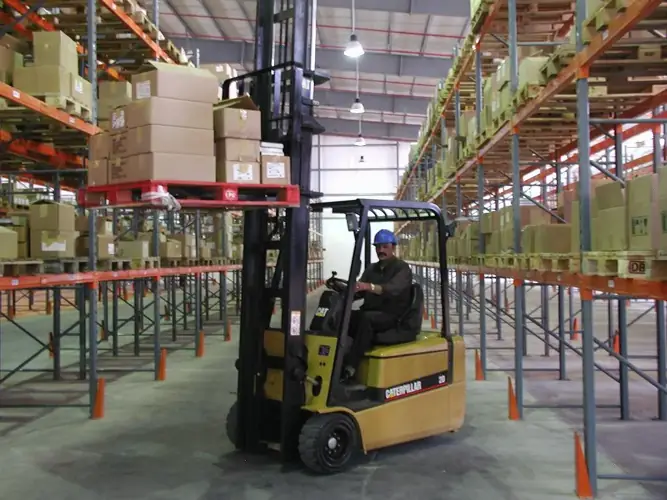
Consorzio Logistico Latina Scalo carries out third-party goods handling at the Via della Dinamica site, Tor Tre Ponti area, Latina Scalo (LT): goods receipt, picking, packing, labelling, palletising and cross-docking. Operations take place in the site’s buildings, 19,000 square metres of covered space in modules of 500 to 3,000 square metres, served by covered loading and unloading bays and by yards for articulated lorry manoeuvring.
The service can be contracted together with storage, when goods remain in the warehouse, or on its own, for transit flows or operations on specific batches. The Consortium states that it operates 24 hours a day, 7 days a week.
Handling stages
Goods receipt
The vehicle docks at a covered bay. The operator checks the goods against the transport document (DDT, Italian delivery note) and the client’s advance shipping notice, counts packages and pallets, checks the condition of the packaging and notes on the carrier’s document any reservations for shortages or damage. Anomalies are reported to the client on the same day, with the delivery reference.
Recording and put-away
Accepted goods are recorded in the WMS (warehouse management system) and moved to the assigned location, on racking or on the floor. From this point every internal movement is tracked in the system, including replenishment from reserve areas to picking areas.
Picking
Picking is organised according to the order profile:
- full pallet, for B2B deliveries to distribution platforms and retail outlets;
- case pick, for mixed orders bound for retailers;
- each pick, for split orders typical of e-commerce.
For high volumes, orders can be grouped into picking waves to reduce travel in the aisles. The method is set by analysing daily order lines and item turnover.
Packing and palletising
Picked items are checked by code and quantity, packed and prepared for dispatch. Units for pallet transport are built according to the stacking rules specified by the client and secured with stretch wrapping or strapping.
Labelling
Each outbound package or pallet receives the carrier’s shipping label and, if required, product or sales channel labels. More complex operations, such as relabelling or kit assembly, are described on the value-added services page.
Loading and dispatch
Ready units are grouped by destination or carrier in the dispatch area and loaded at the bays. The transport document is issued at loading; goods can leave with the Consortium’s fleet, described on the transport page, or with the carrier chosen by the client.
Cross-docking
For goods that do not need to be stored, the Consortium carries out cross-docking: unloaded goods are sorted by destination and reloaded onto other vehicles without passing through warehouse locations. Dwell times, arrival windows and consolidation rules are explained on the cross-docking page.
Supporting infrastructure
Operations rely on the site’s facilities:
- covered loading and unloading bays and yards for articulated lorry manoeuvring, with vehicle parking areas;
- industrial shelving and clear height up to 10 metres;
- WMS, dedicated fibre-optic connection and industrial Wi-Fi in the operating areas;
- perimeter CCTV, access control and fire protection and intruder alarm systems.
Service start-up
Start-up begins with an analysis of the client’s historical data: item master data with dimensions and weights, average and peak orders, number of lines per order, carriers used. On the basis of these data the Consortium defines the layout of the picking areas, receiving and dispatch times and the information flows between the client’s management system and the WMS, covered on the document management page.
Sectors and areas served
Handling is sized for different profiles: pallet orders for large-scale retail, mixed cases for textiles and fashion, components for automotive and manufacturing. The site serves companies in Latina, Aprilia, Cisterna di Latina and Velletri, the last about 25.1 km by road, as well as the wider province of Latina.
Requesting a quote
For a handling quote, please state the average and peak number of orders and order lines per day, type of units picked (pallets, cases or items), packaging format, seasonality of flows, carriers used and required operations such as labelling or palletising. Requests can be sent via the contact form.